: Memory is treated exactly like an operating system directory. Raw multimodal inputs—such as code, text documents, image data, and raw voice notes—are saved permanently in their original form. Crucial facts are then extracted and organized into human-readable Markdown category files that can be navigated, mounted, or exported.
Multimodal Inputs (Audio, Docs, Text) │ ▼ [memU Extraction Layer] │ ▼ ┌─────────────────────────────────────────┐ │ Memory File System Structure │ │ ├── Daily Logs (YYYY-MM-DD.md) │ │ └── Long-Term Categories (Finance.md) │ └─────────────────────────────────────────┘ │ ▼ [Graph & Semantic Indexing] ──► Autonomous Proactive Action Real-World Proactive Use Cases : Memory is treated exactly like an operating
: The framework tracks research history and past reading choices. It proactively surfaces new academic papers or documents that align precisely with ongoing projects. Multimodal Inputs (Audio, Docs, Text) │ ▼ [memU
: Facts are not kept in isolated files. Individual memory blocks are cross-linked to form complex knowledge graphs. This architecture mirrors biological memory pathways, enabling an agent to jump from broad themes to granular facts effortlessly. Proactive Operations: Moving Beyond Reactive Prompts Individual memory blocks are cross-linked to form complex
In the evolving landscape of Artificial Intelligence, large language models (LLMs) often struggle with a fundamental limitation: they are inherently stateless. Traditional AI tools operate on a rigid reactive loop where context resets after every session, forcing the model to re-learn user preferences, goals, and history from scratch. is a breakthrough open-source agentic memory framework that solves this issue by providing AI agents with persistent, long-term, and hierarchically organized memory structures. It functions as a living brain, allowing autonomous agents to systematically store, organize, and reason over multi-modal data in real-time. Key Architectural Pillars of memU
Comparative Analysis: memU vs. Traditional Memory Implementations Feature Matrix Vector RAG Systems Standard Conversational Buffers memU Agentic Framework Flat vector indexes Raw message text strings Hierarchical Markdown & Graphs System Behavior Reacts only to explicit prompts Follows limited context rules Acts proactively 24/7 Token Efficiency High token bloat from chunking Exceeds context window limits Highly compressed structured lookup Data Continuity Lacks contextual relationships Erased completely after sessions Persistent and portable files Production Benefits for Enterprise Developers
Deploying memU via the official Python package memu-py yields distinct infrastructure optimizations for live operations: NevaMind-AI/memU at blog.yuv.ai - GitHub
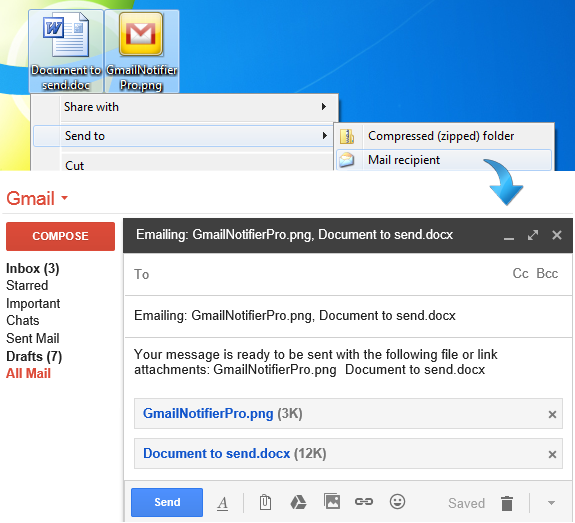
Gmail Notifier Pro can be registered as default program for e-mail in Windows. When registered as default e-mail program in Windows, the task of sending e-mail attachments from Windows, Office or any other applications becomes easy.
The screenshot illustrates the Send To feature that is available for all files and folders in Windows. By selecting one or many files, selecting Send To - Mail recipient, Gmail Notifier Pro Gmail can be opened in the web browser with a new message prepared, including the selected files as attachments. This integration increases the productivity for Gmail users.
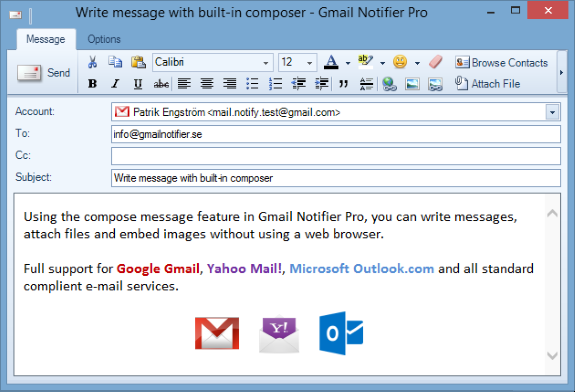
Gmail Notifier Pro also have a built-in e-mail composer that can be used for sending messages. The Send To feature can either be used with Gmail in the web browser or the Gmail Notifier Pro composer.
Gmail Notifier Pro also supports mailto-link integration, and can either launch the Gmail composer or the Gmail Notifier Pro composer when a mailto-link is clicked.
Supports 32-bit & 64-bit Windows XP, Windows Vista, Windows 7, Windows 8 and Windows 10.
Gmail Notifier Pro can can be used as an e-mail client, with support for all common message operations, including send e-mail, reply, preview and save attachments, mark as read or delete messages.
The screenshot illustrates the e-mail message composer in Gmail Notifier Pro.
Gmail Notifier Pro has preconfigured settings for all major e-mail service providers, making it easy to get started. Gmail Notifier Pro can also be used with any standard IMAP or POP mail server. For Google, messages can be accessed using Atom in addition to IMAP.
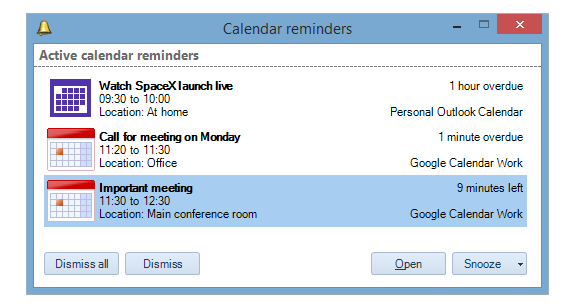
Gmail Notifier Pro can connect to Google Calendar and Microsoft Outlook.com Calendar in order to get information about calendar events and display reminders.
The screenshot illustrates the calendar reminders. These reminders will popup on the Windows desktop to notify about the events.